
Burned-Out Executives Are Booking Retreats for Their Nervous Systems
A new Forbes article published this week captured something that practitioners working in the wellbeing space have known for years — and that the broader culture is only now beginning to understand. High-performing professionals aren't just burnt out. They're arriving at their holidays already depleted, entering recovery mode the moment they check in.
The new luxury, the article argues, isn't a packed itinerary or a bucket-list destination. It's the radical act of doing less — intentionally — in an environment designed to make slowing down feel not just acceptable, but physiologically necessary.
The Numbers Behind the Shift
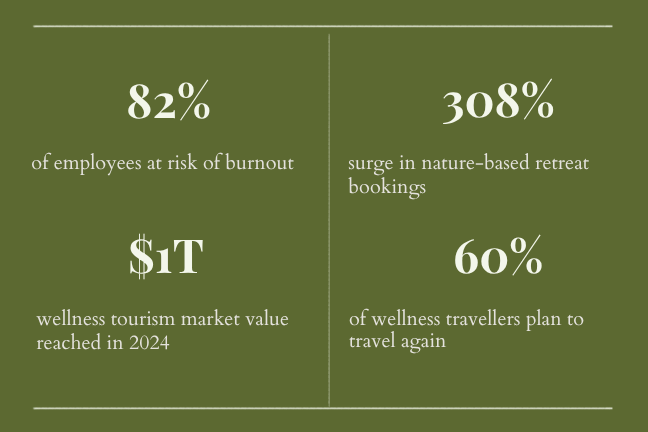
What makes the Forbes piece worth reading is the scale it documents. These are not niche trends. They describe the mainstream experience of professional life in 2026.
82% of employees currently at risk of burnout
60% of wellness travelers plan to travel again
$1T wellness tourism market value reached in 2024
308% surge in nature-based retreat bookings in a single year
The term "nervous system regulation" — once the language of somatic therapists, yoga teachers, and those of us who've been working in this field for years — has entered mainstream corporate conversation. Not because it's fashionable. Because it describes something real that millions of people are experiencing in their bodies and can no longer ignore.
What This Means for Practitioners
For those of us who work with burnout, stress, and nervous system health, the Forbes article validates what client intake conversations have been revealing for some time. People are arriving more depleted than they used to be. The gap between how they're functioning and how they need to function is wider. And the old approaches — a long weekend, a massage, a mindfulness app — aren't closing it.
"People aren't just booking massages. They're seeking nervous system relief, mental clarity, and distance from the constant demands of work."
Heike Pacchetti, General Manager, Farmhouse Inn — via Forbes
This is a meaningful clinical and commercial signal. The clients coming to you are ready — perhaps more ready than they've ever been — to invest in a genuine, immersive reset. What they need is a container worthy of that readiness.
Why the Setting Is Part of the Treatment
The Forbes piece highlights nature-based and countryside settings as the fastest-growing category in wellness travel. The reason isn't aesthetic — it's neurological. Natural environments engage what psychologists call "involuntary attention," allowing the directed attention we deplete through cognitive work to quietly restore itself. You can't replicate this in a studio, a hotel, or an urban retreat centre. The environment has to do its own work.
This is something we observe consistently at Parohe. Guests who arrive visibly braced — tightly scheduled, over-stimulated, still half-present to their inboxes — go through a discernible shift within the first few hours on the island. The water crossing from Sandspit signals to the nervous system that something genuinely different has begun. The native bush, the harbour light, the complete absence of traffic and city noise — these aren't incidental. They're doing physiological work before the first session starts.
For practitioners designing retreat programmes, this matters enormously. When the setting is right, you don't have to work as hard to drop the group in. The environment regulates them. What you facilitate from that point lands deeper, integrates more fully, and stays longer.
The Anti-Hustle Reckoning
The Forbes article frames this as a generational correction. Millennials, now in leadership positions, are rejecting the equation of ambition with depletion. Anti-hustle culture, as one retreat director puts it, is not laziness — it's people recognising that sustainable performance depends on actual recovery, not just the appearance of it.
This is the cultural moment that wellness practitioners have been preparing people for. The clients walking into your studio or your practice right now are living it. They're not just looking for techniques to manage stress within their current lives. Many of them are ready for something more fundamental — a few days in which the environment itself gives them permission to be human again.
That's what a retreat on Kawau Island offers. Not a holiday. A recalibration.